
A DAO begins with an idea of doing something in common. I see the creation of a DAO as a calling for help to others to achieve goals that you may see unreachable by using your own resources and capabilities. At the same time, all those goals are thought to help others in one or many ways.
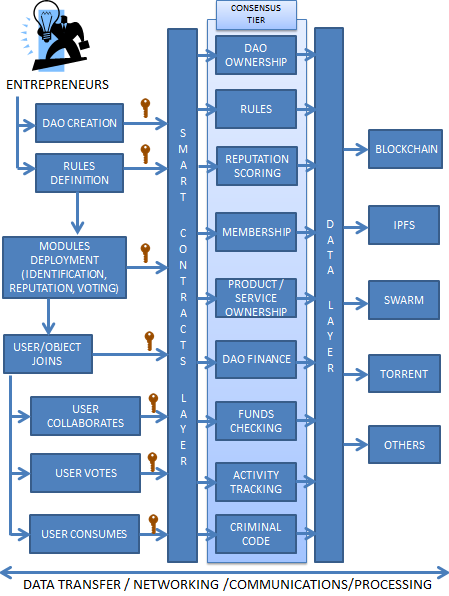
All DAO processes can be grouped into three tiers: front-end tier, consensus tier, and database tier as shown below from left to right,
FRONT-END TIER
The ones who got the idea and launched a DAO are entrepreneurs. In an ideal world, they would have an ease-of-use front-end for DAO creation, rules definition, and technical deployment. Upcoming users will have also easy-to-use tools for joining and operating in the DAO environment. Operating with these front-ends requires identification. It is also very important to take into account that objects (products and services) traded in a DAO environment must join it and get a token or an identity that can be used later in a contract.
The front-end tier shows the need for user-friendly tools to make DAOs run and grow. Projects like Backfeed (http://backfeed.cc) make much sense here as it is defined as an operating system for running decentralized organizations.
CONSENSUS TIER
Anything done in a DAO environment is confirmed under consensus. Voting systems and automated algorithms that apply rules previously defined, of course under consensus, are what make all DAO operations trusted and “legally” approved. Just following DAO rules makes all operations valid, avoiding common resources wasted in bureaucracy-related processes, just for registering and confirming transactions. The consensus offers a system where laws are defined democratically and operations are performed at a very fast pace and efficiently.
We can say that the main result of DAO member’s consensus is law. As an Embracing Agents ecosystem goes forward, laws will be getting better, but we would never say that they will be perfect. Things done legally would not always be moral and things done cannot be undone. The only way to use a moral code which is not defined before in the DAO’s rules, but is consensual afterwards, is to execute a criminal code when an agreement is reached democratically. This criminal code could include performing an automated operation to fix the mistakes made (i.e.: execute the opposite operations which were done in an immoral manner before) and/or to drop the reputation value of people who performed those immoral operations. At the same time, rules must be updated to include moral agreements as laws for future interactions.
Consensus is everywhere in a DAO. Laws, membership, rules, policies, criminal code, voting systems, reputation, transactions, etc. are confirmed by consensus. That consensus could be applied just to a specific DAO or to a whole ecosystem of DAOs due to global databases, global machines, and global networks.
DATABASE TIER
Anything done in a DAO environment is also tracked and stored in a database. DAO’s operations could be stored in a ledger shared with other DAOs (this is what makes possible an ecosystem of DAOs) which best current technology is the Blockchain, while other operations could be stored separately in other databases for specific purposes using different technologies like IPFS, BitTorrent or Swarm.

 DIMCredits
Leave a comment