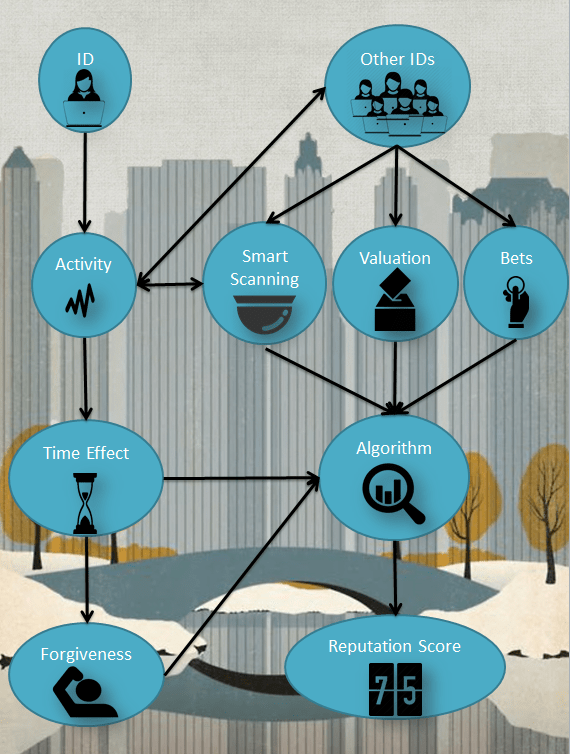
In this article, I want to explain basic design topics for reputation scoring that could be implemented in any DAO and also could be the main process workflow for a global reputation scoring DAO integrated into any other DAO technical architecture.
Reputation is everywhere. Votes, opinions, comments, shares, likes, retweets, etc. feed identities (persons or other things) reputation. Every choice we make for buying, playing, or just interacting is based on reputation scores coming from our own or from others. It is a matter of trust and feeling secure.
Every score any identity could get comes from her activity. That activity means a value for other people or for an artificial intelligence machine after processing it with a specific algorithm (i.e.: do not stop when a traffic light is red means bad driving behavior) which must be approved by the consensus of all members involved. So for a given activity, one or many reputation scores are added and could be computed by an aggregation algorithm to calculate a global single score.
Time is a significant variable to compute reputation scores. Activities performed a long time ago, are suitable for getting less influence on the global reputation score of an identity. Related to it, the forgiveness right is very important as someone who is 50 years old should not be scored for what she did when she was a teenager.
Prediction markets are also another vehicle to compute reputation from what other identities bet. From a prediction market result, it can be concluded a reliable reputation score.
It is also important to take into account that all given values for an identity: likes, shares, votes, evaluations, comments, bets, etc. have a lot of influence on upcoming reputation-related interactions.
This design is independent of any technology. It can be implemented under blockchain, hashgraphs, or any other to achieve consensus and trust between all participants.
A trusted reputation scoring system will be a core functionality for an advanced society which will avoid most of the current injustice, giving more to people who deserve more by helping society as a whole. A reputation-based social system could increase fair contributions between us, could provide a real competitive environment with no losers, and could set trusted organizations.

 DIMCredits
Leave a comment